
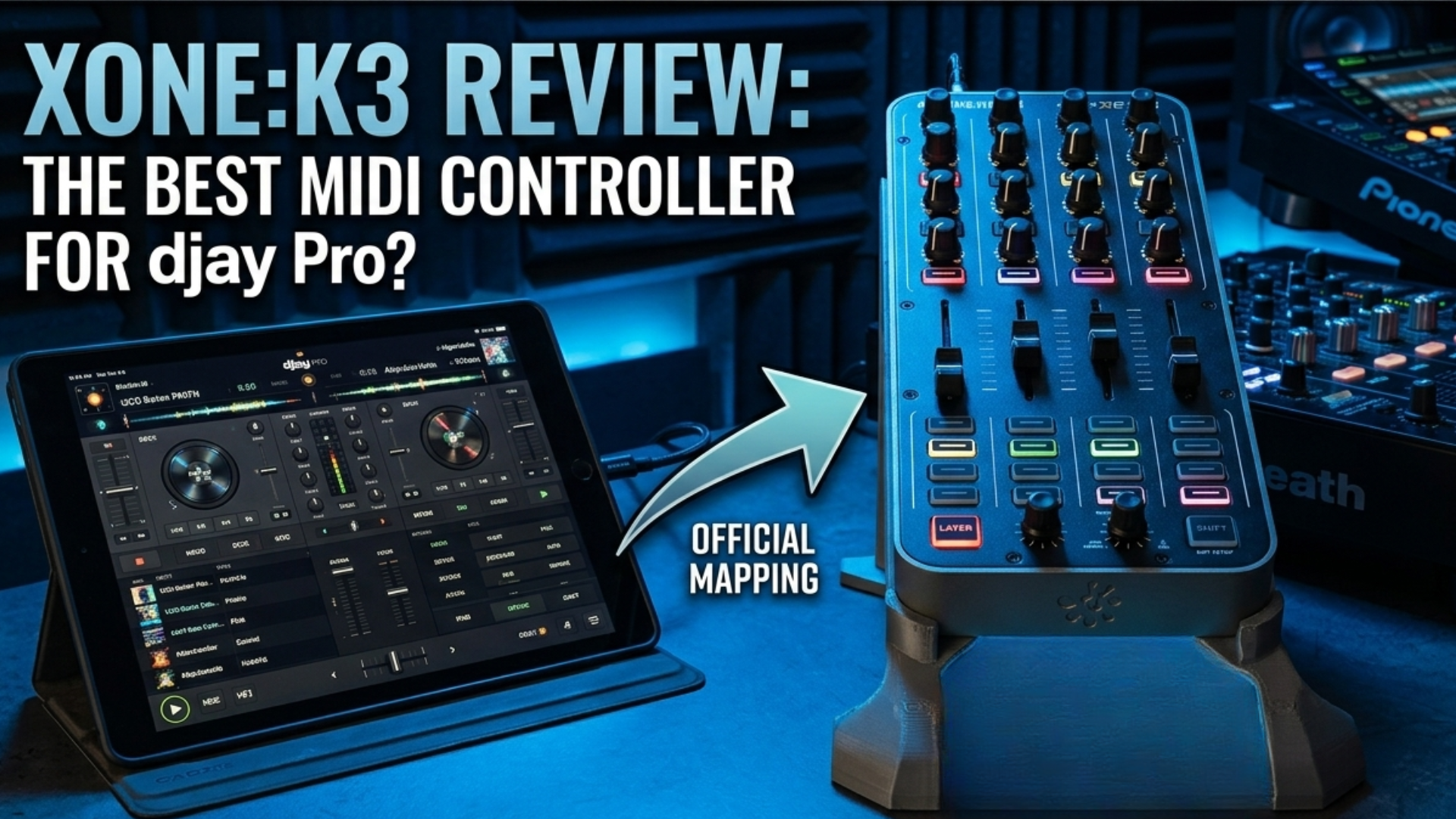
Allen & Heath has been making modular MIDI controllers for DJs for years, and the Xone:K2 built up a serious following in that time. So when the Xone:K3 dropped in October 2025, there was already a crowd of DJs paying close attention. The K3 isn’t a reinvention, it’s a refinement, and in a lot of ways that’s exactly what was needed. But the bigger story here isn’t just the hardware upgrade. It’s what happens when you pair the K3 with Algoriddim’s djay Pro and a custom mapping that Allen & Heath and Algoriddim built together. That combination is genuinely exciting, and it fills a gap in the market that’s been empty for a while.
What’s new in the K3
If you know the K2, the K3’s layout is going to feel immediately familiar. Allen & Heath kept the same basic formula that made the K2 popular. What they changed is everything that needed changing. The biggest wins are the diecast metal chassis, nutted pots, and tactile switches that make this thing feel genuinely road ready. Pick it up and it feels like gear that’ll still be working five years from now. The old K2 felt solid. The K3 feels like a tank.
The LEDs have been upgraded to full RGB backlighting across all buttons and encoders. This isn’t just cosmetic. The color coding tells you instantly which layer you’re on and helps you navigate your mappings in a dark booth without having to think about it. USB-C replaces the dated USB-B connection from the K2, and the unit is bus powered so there’s one less cable to deal with. The K3 also supports X:Link connectivity, which means you can chain it directly into Allen & Heath mixers like the Xone:96, PX5, 43C, and 23C.
Across the 52 physical controls, including 30 buttons, 12 rotary pots, 6 endless push encoders, and four 60mm faders, you get three fully independent layers. That gives you up to 174 assignable MIDI parameters per mapping. For a controller this compact and this affordable, that’s a serious amount of control real estate. Street price is $249, with B-stock units available from around $202.
One thing worth flagging: Allen & Heath dropped the built-in audio interface that the K2 had. If you were using the K2 as your audio out, you’ll need to account for that. It’s a trade-off that brings the price down and keeps the unit slim, but it’s worth knowing upfront.
The djay Pro connection and why it matters
Here’s where the K3 story gets really interesting. Allen & Heath and Algoriddim collaborated on an official three-layer mapping for djay Pro that covers roughly 90 to 95 percent of the software’s capabilities. That’s not a community mapping someone put together on a weekend. That’s a proper partnership, and you can feel the difference when you use it.
The three layers break down like this. Layer one handles the basics, four decks with play, load, volume faders, EQ, loop selection, and a three-part stem control setup. Layer two goes deeper with dedicated deck selection for advanced stem control, effects, tempo nudging, filters, key lock, and hot cues. Layer three is fully dedicated to controlling djay Pro’s sample decks and looper functions. The color coding on the RGB buttons makes switching between layers and knowing where you are completely intuitive, even if you’re learning the mapping from scratch.
For djay Pro users who’ve been frustrated by the lack of proper hardware support for the software’s more advanced features, this mapping is a genuine answer to that problem. The K3 is currently the controller that unlocks the most of what djay Pro can actually do. If you’re a djay Pro user and you’re still mixing with a mouse for half your workflow, this is the hardware that changes that.
What about Traktor and Virtual DJ?
Virtual DJ has a mapping available for the K3, but the layer system in it is reportedly confusing and not as intuitive as the djay Pro setup. It works, but it doesn’t feel like a first class integration. Traktor is a bigger gap. There’s no robust out-of-the-box Traktor mapping for the K3 right now, which is a real miss given how many DJs are still on Traktor as their primary software. If you’re a Traktor user, the K3 is going to require some DIY mapping work to get the most out of it.
The 3D printed stand fix
One practical note worth mentioning. The K3 sits very low profile on a desk or booth, which can feel awkward ergonomically when it’s sitting next to a standard height DJ mixer. There’s a community solution for this: a custom 3D printed stand file available on Printables that raises the K3 to the exact height of a standard DJ mixer. If you’ve got access to a 3D printer, or know someone who does, it’s a simple fix that makes the whole setup feel a lot more natural to use.
Real talk
The Xone:K3 is a well built, reasonably priced modular MIDI controller that makes a lot of sense for the right DJ. If you’re a djay Pro user, it’s currently the best hardware option for getting full control of the software, and the official Allen & Heath and Algoriddim collaboration mapping is the reason why. The build quality is excellent for the price, the RGB layer system works well in practice, and the USB-C update was long overdue.
The lack of a solid Traktor mapping is a gap that should be filled. But at $249 for a controller that’s this well made and this capable when paired with djay Pro, it’s hard to argue with the value. If you’re building a modular setup and djay Pro is your software, the K3 belongs on your shortlist.