For over a decade, the premium beat-making controller market has been a two-horse race: Akai’s MPC line and Native Instruments’ Maschine. Each platform developed a loyal, almost tribal following, but the core design principle remained the same, a tight ecosystem of hardware and software built primarily for dedicated producers.
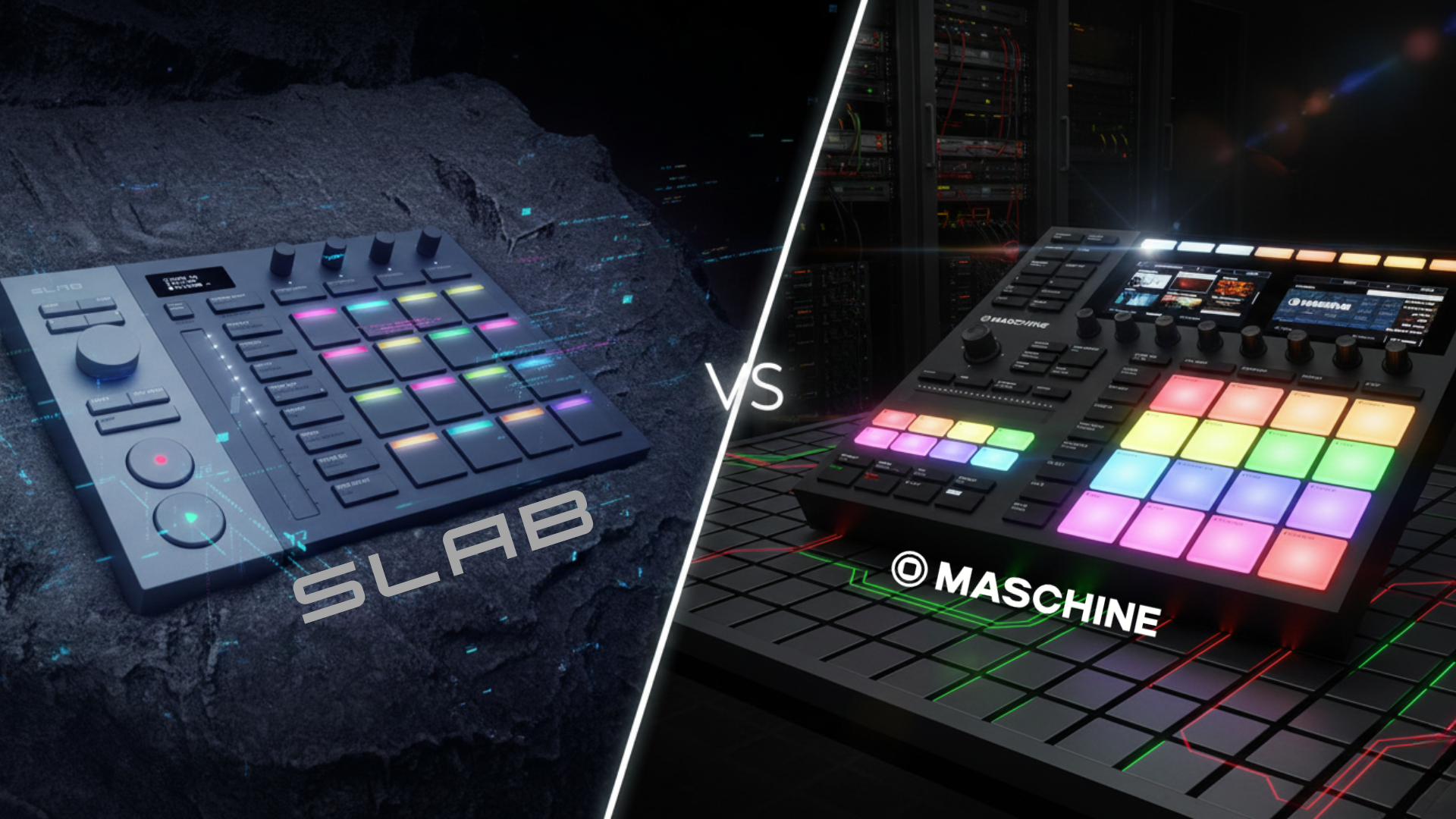
Now, with the Serato SLAB, AlphaTheta and Serato have jointly launched a dedicated controller that doesn’t just copy the competition; it fundamentally repositions itself around the one massive community the other brands haven’t fully conquered: the working DJ. The SLAB is a direct challenge to the Maschine ecosystem, and it forces a crucial question: Will this new focus on the DJ-to-Producer workflow leave Maschine playing catch-up, or does Native Instruments still hold the advantage?
The SLAB’s Superpower: The Serato Ecosystem
At its core, the Serato SLAB is designed to be the definitive controller for Serato Studio. It brings the familiar feel of DJ hardware, the rugged build, the responsive pads, the intuitive dial, directly into the beat-making environment. This tight integration is its primary superpower, offering a level of plug-and-play simplicity that aims to lower the learning curve for the hundreds of thousands of DJs already familiar with the Serato interface.
The Hybrid Advantage: The SLAB’s design is a strategic masterstroke because it’s a triple threat. It works seamlessly as the core control surface for Serato Studio, a dedicated performance tool for the Serato Sample plugin inside any DAW, and a functional Official Serato Accessory (OSA) for Serato DJ Pro. This allows one piece of hardware to truly bridge the gap between the DJ booth and the studio desk. You can use the SLAB’s Stems control features to isolate a bassline for a remix in Studio and then use the same hardware to trigger cues and samples in a live DJ set later that night. No remapping, no headaches.
The Stems Workflow: With the deep Stems integration across the entire Serato ecosystem, the SLAB immediately excels in one of the most important new areas of music creation. Producers who rely heavily on sampling and flipping acapellas are finding the combined speed of Serato Sample and SLAB’s dedicated controls superior to older sampling workflows. As one producer noted, the way Serato handles stretching and tuning samples can “ruin any other sampler for you.” The SLAB gives that lightning-fast workflow a dedicated home.
The Elephant in the Room: What Happens to Maschine?
The Serato SLAB attacks the Maschine ecosystem from a unique and devastating angle: market share.
Maschine’s strength lies in its deep, complex software and its immense library (Komplete integration). However, its biggest weakness for many is its proprietary nature and the learning curve required to master its workflow.
The SLAB, with its sub-$300 price point and free Serato Studio license, directly targets the budget-conscious beatmaker who might otherwise have bought a Maschine Mikro or an entry-level Maschine MK3. Why?
- Workflow Simplicity: The SLAB is intentionally stripped-back. Its creators prioritized speed and intuitiveness over screen real estate and complex menus, appealing directly to the hip-hop and electronic producers who value getting ideas down fast.
- Targeted Audience: The enormous global install base of Serato DJ Pro users are the SLAB’s ready-made customer. They already speak the Serato language. Native Instruments is now forced to compete for the producer who is already a loyal customer of their rival’s software.
If the goal of the SLAB is to pull new producers from the DJ community into the Serato Studio ecosystem, it will inevitably chip away at the new-user pipeline for Maschine.
Maschine’s Defense: The Power of Legacy
Despite the SLAB’s aggressive entry, Maschine still holds substantial advantages that will ensure its survival.
- First is Standalone Capability. The Maschine+ is a powerful standalone device, offering production without a computer, a feature the USB-powered SLAB cannot compete with. For the producer who wants true mobility, Maschine+ remains the industry standard.
- Second is Software Depth. The Maschine software, especially with the recent 3.4 update, is a more mature and complex production environment. Its integration with the entire Native Instruments Komplete universe of synths, effects, and sounds is unmatched. The recent updates, including the new modulation editor and advanced automation curves, have deliberately closed the gap between the performance-focused groovebox and the traditional DAW.
The Future Beat: Awesome Potential
Looking ahead, the SLAB’s collaboration with AlphaTheta suggests a bright future. AlphaTheta is a hardware giant. If the SLAB proves successful, the potential for a SLAB+ or a Standalone SLAB with an embedded computer (mirroring the Maschine+ and MPC Live) is enormous. Imagine a dedicated Serato Studio box that boots up instantly, ready to sample and sequence without a laptop.
This product has the potential to become the ultimate all-in-one hybrid production and performance tool for the modern beatmaker. It will force Native Instruments to either double down on their standalone market or finally open up Maschine to deeper integration with rival DAWs and sampling methods to defend their ecosystem.
For the artist, this competition is nothing but a win. The Serato SLAB has injected a massive dose of innovation and competition into a stagnant market, ensuring that whichever controller you choose, the future of beat-making is faster, more tactile, and more powerful than ever before.